
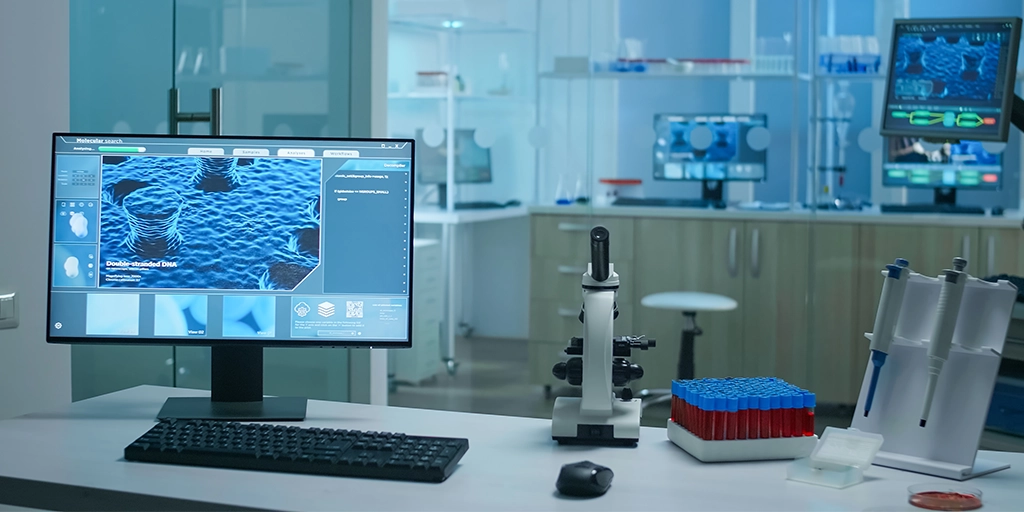
Setting up your first biotech lab: A founder’s guide to water purification systems
There’s lots to think about when setting up a biotech lab, from the people and processes to the equipment and controlled conditions.
While attention often gravitates towards instrumentation in laboratory settings, the underlying infrastructure upon which a biotech lab is designed to run has a significant bearing on how critical experiments can perform and scale over time.
Chief among these considerations is water management. Indeed, purified water is an essential reagent within a range of molecular experiments, with the quality of water used influencing scientific findings, the lifespan of costly equipment, and important activities such as cleaning.
Carefully considering and prioritising water purification methods is therefore crucial to ensure the smooth running of key biotech lab workflows. Conversely, if impurities are present, then a host of problems such as experimental inconsistencies can emerge.
Therefore, making the right choice when it comes to biotech laboratory water purification should be a strategic priority, selecting start-up lab water systems that will enable long-term success.
Why water quality matters in biotech contexts
For this reason, making the right choice when it comes to biotech laboratory water purification should be a strategic priority. Even small variations in water quality can have a major bearing on reactive performance – particularly in cell environments, where growth rates, viability and reproducibility can all be impacted.
Once you move into regulated areas such as GMP, ATMP, cell and gene therapy, water stops being a background utility and becomes something you have to get exactly right. In most cases, that means working at an ultrapure level as standard.
It’s not just a compliance issue either. If you’re using analytical tools such as high-performance liquid chromatography (HPLC) or mass spectrometry (MS), then trace contaminations can undermine data reliability.
It’s for these reasons that the majority of setups don’t rely on a single purification method or step, but take a layered approach, combining reverse osmosis, electro-deionisation, and UV.
Understanding the three water purity grades
For biotech lab founders working through a laboratory setup checklist, there are several grades of purified water to be aware of. It’s important to note that the standard Type I, II, and III classifications are defined by electrical resistivity and conductivity – that is, how many dissolved ions are present – and also take into account total organic carbon (TOC) levels, but do not in themselves cover biological contaminants such as bacteria, endotoxins, DNases, or RNases. Where these are relevant to your application, additional specifications and purification steps are required (see below). Furthermore, the standard classifications do not account for endotoxin removal. For applications where endotoxins must be eliminated, such as cell culture or injectable preparations, Type I plus or Type II plus water is required.
Bacteria and endotoxins often coincide and must be considered together: gram-negative bacteria release endotoxins (lipopolysaccharides) upon cell death, so water contaminated with bacteria is typically also contaminated with endotoxins. Both can compromise cell visibility, trigger inflammatory responses in biological assays, and invalidate experimental results. Equally important for many molecular biology workflows are DNases and RNases – enzymes that degrade DNA and RNA respectively. Even trace levels can destroy nucleic acid samples, rendering techniques such as PCR, RT-PCR, and next-generation sequencing (NGS) unreliable. Water used in DNA- and RNA-based applications must therefore be confirmed free of these enzymes, either through dedicated purification steps such as ultrafiltration or UV irradiation, or by using certified nuclease-free water.
Type I: Ultrapure water
Ultrapure water, as its name suggests, is the highest purity grade achievable, and is virtually free from impurities. The process of producing ultrapure water starts with pre-treatment, usually through an activated carbon adsorption filter followed by reverse osmosis water filter (RO). Subsequently, a deionising water system is employed in addition to ultraviolet (UV) water sterilisation and total organic carbon (TOC) reduction.
With resistivity of 18.2 MΩ.cm, and extremely low conductivity, it also achieves very low TOC levels (typically ≤5 ppb). It is suitable for applications such as molecular biology experiments, atomic absorption spectroscopy, mass spectrometry, and high-performance liquid chromatography (HPLC). However, Type I water alone does not guarantee endotoxin removal.
Type II: Purified water
Type II water is good for applications that don’t require the highest levels of purity, being pure enough for some specialised use as well as general lab applications. You’ll usually get there through a mix of basic filtration, carbon treatment, reverse osmosis, as well as some form of deionisation (either ion exchange or EDI), often finished with UV and fine filtration.
In terms of spec, it typically sits above 1 MΩ.cm resistivity with conductivity below 1 µS/cm, and TOC levels are typically below 50 ppb. In practical terms, that makes it suitable for things like buffer prep, reagent mixing, dilutions, routine microbiology work, and general analytical tasks where you don’t need absolute baseline sensitivity. As with Type I water, this classification is based on ionic purity and TOC, but does not address endotoxin, bacterial content, DNase or RNase activity.
Type III: General grade water
Type III water, meanwhile, isn’t designed for precision tasks, but plays an important role in the background, used in tasks where ultra-high purity isn’t necessary. Production methods are simpler too, often involving reverse osmosis or basic filtration, sometimes paired with distillation or ion exchange depending on the setup.
Even though it sits at the lower end of the scale, it’s still defined and controlled, typically with resistivity above 4 MΩ.cm and conductivity under 0.25 µS/cm, with TOC typically below 200 ppb. Often in lab environments, Type III water is used for rinsing glassware or feeding autoclaves. It is not specified for biological cleanliness and should not be used in applications requiring control of bacteria, endotoxins, or nucleases.
Type I Plus and Type II Plus: endotoxin-free water
Where endotoxin removal is a requirement — for example in cell culture, tissue engineering, or the preparation of reagents used in sensitive biological assays — standard Type I or Type II water is not sufficient on its own. In these cases, Type I Plus or Type II Plus water is needed.
These grades build on their standard counterparts by incorporating an additional ultrafiltration step specifically designed to remove endotoxins, bacteria, and other pyrogens. Type I Plus delivers ultrapure water at 18.2 MΩ.cm with endotoxin levels typically below 0.001 EU/mL, making it suitable for the most demanding biological applications. Type II Plus offers a similarly endotoxin-reduced profile at the purified water grade, appropriate for applications such as cell culture media preparation and molecular biology work where biological cleanliness is critical but absolute ionic purity is not the primary concern.
It is also worth noting that for DNA- and RNA-sensitive applications – such as PCR, RT-PCR, or transcriptomics – neither the standard nor ‘Plus’ grades formally specify DNase or RNase absence. In these cases, water should be verified as nuclease-free, either through the use of certified nuclease-free products or confirmed through testing. Some manufacturers offer Type I Plus water with additional nuclease-free certification for those workflows.
When specifying your water purification system, it is therefore essential to consider not just resistivity requirements, but whether your workflows demand endotoxin, bacterial, control or nuclease-free water — and to select the appropriate grade accordingly.
Choosing the right system: key considerations for founders
For founders sourcing essential equipment for biotech start-ups, the ability to switch between different purity grades to achieve consistent, on-demand water at defined quality levels can pay dividends long term. Indeed, they enable labs to scale from early experimentation into more structured and regulated environments such as GMP, ATMP or cell and gene therapy, without having to revisit and invest in core infrastructure.
To achieve this, infrastructure planning benefits from early consideration. Aligning with validation frameworks such as installation qualification (IQ), operational qualification (OQ) and performance qualification (PQ) confirm a system has been installed, functions and perform as intended.
Further, it’s important to ensure that water purification solutions should be suitable for not only today’s needs, but also tomorrow’s, supporting evolving requirements as workflows diversify as purification needs and regulatory demands change.
Technologies should be proven, easy and quick to install, and simple to use and maintain. They should also support sustainability goals, operating efficiently with low energy consumption.
How Purite supports biotech start-ups
Purite works with life sciences organisations across the UK to design and deliver water purification strategies tailored to both early-stage requirements and long-term growth.
Our water purification technologies use advanced combinations of reverse osmosis, electro-deionisation, and ultraviolet technologies deliver Type I, II, and III water – as well as Type I Plus and Type II Plus for applications requiring endotoxin and bacterial removal – reliably and consistently.
From off-the-shelf offerings to bespoke solutions, we can meet a broad variety of biotech laboratory application and requirements, backed by installation, commissioning, validation support, training, and long-term maintenance services.
For biotech laboratory founders, choosing the right lab water system from day one is fundamental to reliable results, smooth workflows, and long-term compliance. Explore Purite’s laboratory solutions to see how we can help you focus on your research goals – and build a system that scales with you.