
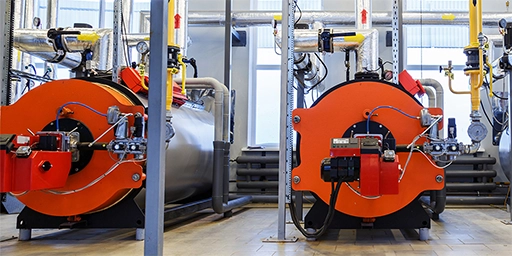
Protecting boilers with effective water pre-treatment
In industrial and commercial environments, boilers are operationally fundamental. From the food and beverage sector to pharmaceuticals and chemicals, high volumes of heat and steam are often needed to support essential manufacturing processes.
In many industries, boilers are run at high loads around the clock. Ensuring they operate efficiently and reliably is therefore vital to avoid issues, maximise service life, and keep ongoing running costs to a minimum.
Understanding the criticality of water quality
Often, many of the potential issues with boilers stem from the water that they use.
Water is the medium through which boilers can transfer heat. However, with boiler feedwater often coming directly from local mains supplies, treating it is imperative to prevent unwanted particles, minerals or gases from circulating through the boiler system due to the issues they can create.
When water is heated and converted into pressurised steam by the boiler, any impurities become concentrated. When these are left behind, they can gradually begin to build up over time, potentially damaging the boiler or compromising its efficiency.
In industrial and commercial environments, those inefficiencies can have a disproportionate impact. Indeed, even minor issues can lead to significantly higher operating costs over time since boilers will likely be running continuously and at high load.
The three leading issues impacting boiler efficiency
Scaling is one of the most common issues that arises from poor water quality in boilers. It occurs when salts such as calcium and magnesium are left behind and adhering to the boiler’s metal surfaces. As these build up in layer upon layer, unwanted insulation occurs between the water and burner. Over time, more fuel will then need to be consumed to fire the boiler to higher temperatures in order to produce the same amount of steam.
Corrosion is another problem that emerges when dissolved gases like carbon dioxide or oxygen enter the boiler. When the boiler is fired, these gases can react with the boiler’s internal metal surface, eventually resulting in the thinning of that metal. Not only does this impact the system’s pressure over time, again reducing its efficiency, but it can also create issues such as leaks which will ultimately require costly repairs or replacements.
In addition, boiler fouling can also arise from the accumulation of soft deposits like sludge oil, organic matter or suspended solids on internal surfaces. Typically stemming from the poor treatment of feedwater, these solids can settle in low-flow areas and impair the boiler’s heat transfer capabilities. And while fouling is generally easier to address than scaling, it can also lead to corrosion if it’s left unchecked.
The importance of filtration, reverse osmosis and ion exchange
Modern boilers are at particular risk of these issues due to their higher heat transfer rates. It’s an innovation that has improved boiler efficiency and compactness over time. However, high heat flux can change the thermal and chemical conditions, potentially accelerating issues of scaling or fouling. Areas prone to hard water can also be problematic due to the higher volume of dissolved solids present in feedwater.
Regardless of your location or boiler model, it is always critical to address feedwater quality through a variety of purification techniques.
Often, the first step involves filtering out suspended solids and organic matter. Once this has been done, reverse osmosis can be used to remove any dissolved salts, minerals and impurities by pushing water through a semi-permeable membrane at high pressures.
Ion exchange is an additional pre-treatment technique that can be used, where resin beads can exchange undesirable ions in the water for more benign alternatives. Calcium and magnesium ions can be replaced with sodium ions, for example, with the former two being leading causes of hardness-related scale. In demanding applications, where high pressure boilers are used, demineralisation is worth considering to produce extremely high purity water.
Selecting the right pre-treatment methods for your needs
Through the right combination of these methods, the effective and comprehensive pre-treatment of boiler water can be achieved, which will go a long way in both preventing problems and maximising boiler efficiency over the long term.
The result is safer operations and lower overall operating costs. Yet achieving these outcomes relies on using a combination of pre-treatment solutions that is tailored to both the local water and boiler system.
Water quality can vary significantly depend on the source, with different dominant contaminants arising in different geographies and water systems. At Purite, we can help ensure that you adopt the most suitable combination of filtration, RO and ion exchange solutions for your specific location and needs.
With over 40 years as a leading UK designer and manufacturer of water purification solutions, we’ve extensive knowledge and experience in protecting boilers for customers throughout industry. Our water purification solutions can improve the efficiency, reliability and safety of your industrial boilers, while reducing the need for blowdown, cutting the use of chemicals and helping you minimise the carbon footprint of your business.
Equally, our RO technology will protect your demineralisation or softening systems, eliminating problems with total dissolved solids, providing a simple and highly effective method of improving your OPEX, with a rapid return on investment.
If you’re looking to prioritise boiler efficiency and performance for the long term, get in touch with our water treatment specialists today to see how we can help.